Vocals
Generated double vs real backing vocals

Human Performance Doubler
GRANDTWIN is not a conventional doubler, delay or modulation effect.
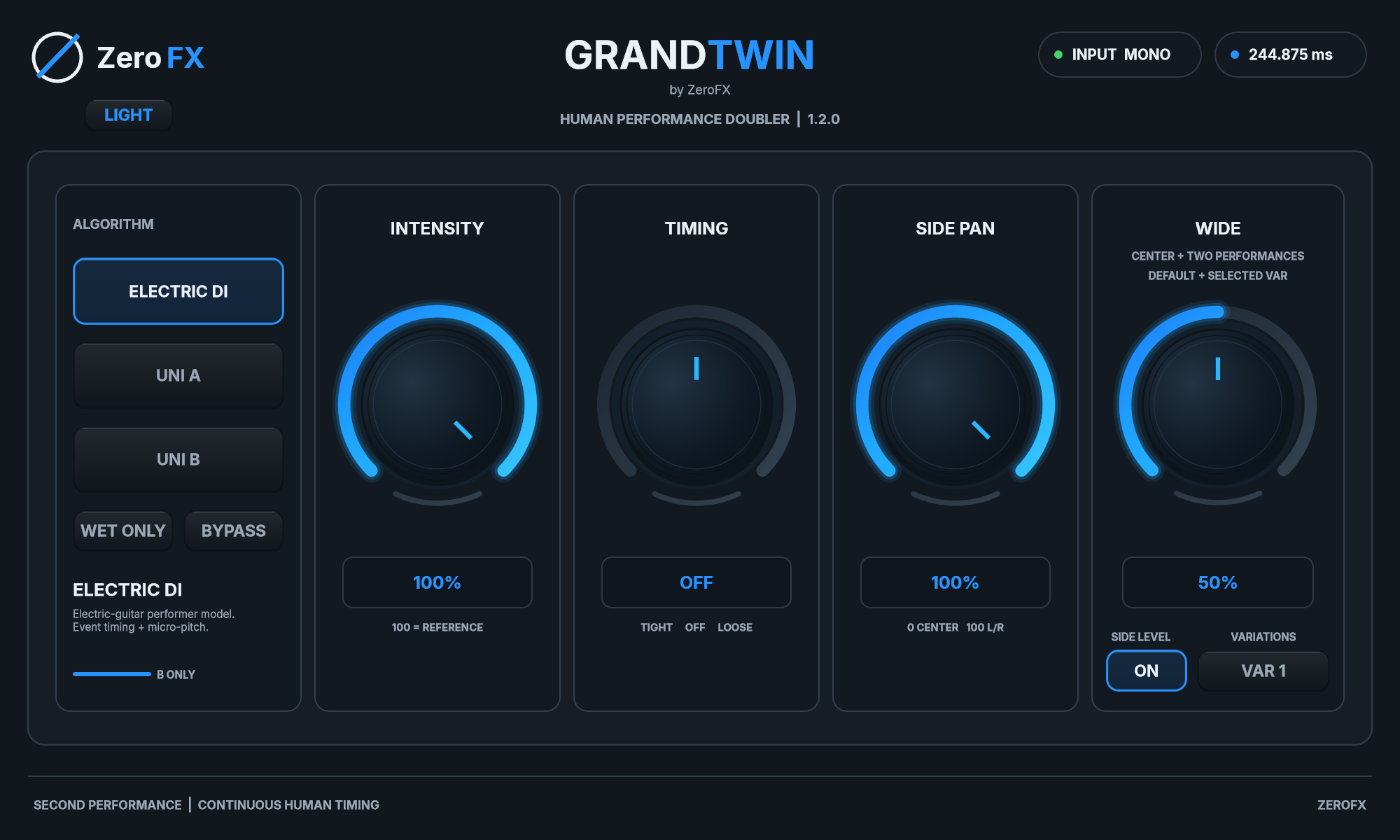
Most doublers create a copy of the source and alter it with delay, pitch modulation or stereo processing. That can make the sound wider, but the copy still remains a copy.
Direct comparisons: GRANDTWIN-generated second performances versus separately recorded real doubles.
Generated double vs real backing vocals
Generated double vs real double track
Generated double vs real double track
GRANDTWIN Wide mode demonstration
It turns one source take into two independently sounding performances, creating natural differences in timing, attack and dynamics — the same details that appear when a person actually performs the same part twice.
The second voice does not feel like a processed duplicate. The two layers interact like a real double-track: they drift slightly apart, shape transients differently and naturally create density and width.
GRANDTWIN does not try to disguise a copy with chorus or micro-delay. Its job is to preserve the character of the source and create another performance of the same part next to it.
The relationship between the two performances is not reduced to one fixed timing shift.
The result is built around performance differences, not an obvious modulation effect.
Width comes from the interaction of two performances, not from masking a duplicated signal.
The source remains recognizable, while the second layer gets its own behaviour.
That makes GRANDTWIN useful wherever a second take would normally have to be recorded manually: vocals, guitars, synthesizers, bass, percussion and other sources.
DEFAULT and VAR 1–6 are separate, repeatable generations of the second performance — not presets or hidden parameter changes.
Each VAR uses its own fixed generation seed, giving the second performance a different timing tendency, micro-pitch identity and motion. Selecting the same VAR again reproduces the same generation identity.
Wide keeps the latency-matched original in the centre and adds DEFAULT plus the selected VAR as two generated side performances. If DEFAULT is selected when Wide is enabled, VAR 1 is used automatically for the second side.
In Wide, Width controls the left/right spread of the two side performances, while Side Level controls their amount. Wet Only removes the centre original and leaves the two generated sides.
Intensity, timing and width controls shape the relationship between the original performance and the generated second performance without turning the result into a conventional modulation doubler.
GRANDTWIN is built for situations where you need more than a wider sound — you need the feeling of a real second take.
One take. Two performances. A true double-track.
Part of the Guitar Bundle: GrandTwin, GrandGate and GrandCab for 3,998 ₽ instead of 5,997 ₽. Three products for the price of two. See the bundle
Windows
